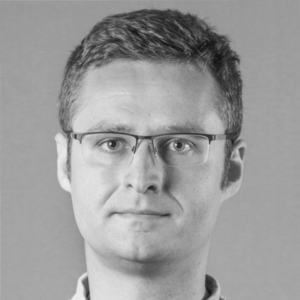
Christoph Busch
member of the Department of Information Security and Communication Technology (IIK) at (NTNU)

Biometrics will be in full swing for the 19th Better AI Meetup! Biometrics today has to solve several significant issues in order to fulfill the expectations of accurate and positive identification and identity verification. Biometric researchers are using AI-based approaches to solve the most important challenges of the technology.
First up, Christoph Busch, from the Norwegian University of Science and Technology and one of the most renowned biometric researchers, will be talking about how demographics affects face image quality and accuracy of biometric identification. He will also introduce techniques on how to mitigate this bias in order to achieve standardized results.
Jakub Nemček, AI researcher from biometric technology provider Innovatrics, will then address issues stemming from challenges posed by lighting, aging, make-up and long-distance image capture, which can be heavily affected by distortion and atmospheric turbulence.





member of the Department of Information Security and Communication Technology (IIK) at (NTNU)
Christoph Busch is member of the Norwegian University of Science and Technology (NTNU). He holds a joint appointment with Hochschule Darmstadt (HDA), Germany. Further he lectures Biometric Systems at Denmark’s DTU since 2007. On behalf of the German BSI he has been the coordinator for the project series BioIS, BioFace, BioFinger, BioKeyS Pilot-DB, KBEinweg and NFIQ2.0. He was/is partner of the EU projects 3D-Face, FIDELITY, TURBINE, SOTAMD, RESPECT, TReSPAsS, iMARS, EINSTEIN and others. He is also principal investigator in the German National Research Center for Applied Cybersecurity (ATHENE) and is co-founder of the European Association for Biometrics (EAB). Christoph co-authored more than 700 technical papers and has been a speaker at international conferences. He is member of the editorial board of the IET journal on Biometrics and formerly of the IEEE TIFS journal.
Furthermore he chairs the TeleTrusT biometrics working group as well as the German standardization body on Biometrics and is convenor of WG3 in ISO/IEC JTC1 SC37.
Talk: Face image quality and demographic variability
Face recognition systems have achieved substantial performance improvements over the past decade. However, their effectiveness remains strongly dependent on the quality of the acquired biometric samples. To assess the quality of face images and in order to verify compliance with ICAO regulations, algorithms and standards have been developed. Recent
investigations have shown that some of the proposed quality measures exhibit significant demographic variability related to skin tone. As a result, the development of unbiased quality assessment algorithms remains an open challenge. The talk will discuss progress towards reducing demographic bias in quality assessment.

AI engineer and researcher at Innovatrics
Jakub Nemček is an AI engineer and researcher at Innovatrics, where he focuses on R&D in biometrics. He studied Biomedical Engineering and Bioinformatics, developing an early interest in image processing and modern AI methods. Before joining Innovatrics, he worked on research projects centered on radiological image analysis. Today, he develops face recognition systems and advances identification and verification algorithms with a focus on accuracy, robustness, and real-world usability.
Talk: Face Recognition in the Real World
Modern face recognition systems can now outperform humans, even under difficult conditions such as aging, make-up, lighting changes, pose variation, long-range capture, and demographic differences. This talk examines how these factors affect accuracy and how to mitigate them. It also looks at recognition at distances of up to 1 km, where optics and atmospheric turbulence become major challenges.
Language: English
Are you frustrated with public services and think AI agents can do a better job? Do you feel that the ability to cooperate with AI is quickly becoming a necessary skill? 18th Better AI Meetup will be all about AI agents and how they are being leveraged to improve public wellbeing.
Andrej Danko from ServiceNow is an experienced leader who together with his team introduces AI agents to public sector services all around the world. He will be showing the experience and best practices of governments that already use AI to simplify their processes.
Peter Šebo from PS Digital will talk about which skills are expected by employers in the AI era and how to acquire them to be “AI-mature”. He will show you the practical skills necessary to turn AI outputs into reliable, trustworthy content and how to avoid common risks such as hallucinations.




In the 17th edition of Better AI Meetup, we will look at robustness and efficiency in large-scale AI. As foundation models become more powerful, the dual challenges of ensuring their security and optimizing their computational footprint have never been more critical.
To tackle these issues head-on, join us for our first-ever joint event. We’re bringing our communities together for a special Czecho-Slovak evening of deep dives and quality networking, featuring Stanislav Fort (AISLE™) and Vladimír Macko (GrizzlyTech) covering both sides of the coin: from the high-level challenge of adversarial attacks right down to the metal with GPU-aware optimization.
Supported by the Slovak Diaspora Project under slovaks.ai, we’re excited to meet the Slovak AI community in person in Prague. While an online option is available (the link to the stream will be sent on November 12th), we hope to see as many of you as possible on-site for the full experience.





In the 16th edition of Better AI Meetup, we will once again discuss regulation and AI, this time focusing on generative AI when it is a part of Very Large Online Platforms.
Martin Husovec, from the London School of Economics and Political Science, will show us how the Digital Services Act may affect the use of chatbots such as ChatGPT in the EU. ChatGPT isn’t currently classified as a Very Large Online Platform (VLOP) under the DSA—but that could change, bringing stricter rules on transparency, risk assessments, and algorithmic accountability.
In the second part of the evening, we will welcome the finalists of the 2nd Trustworthy AI Awards. You will have a chance to discuss with them how to design and deploy AI-based solutions that are ethical and trustworthy.

The 15th edition of Better AI Meetup will be held in Brno! The university in Brno has a deep focus on modern technologies – and a sizeable Slovak diaspora. We will be talking about different aspects of language models and their role.
In the first presentation, Martin Fajčík from FIT at VUT, Brno will introduce the very first benchmark for LLMs in the Czech language: BenCzechMark. Small languages are not well-represented in large language models, which creates specific challenges when using them in real-life applications – and proper benchmarking can help choose the right model for the job.
In the second part of the evening, Jakub Špaňhel from Innovatrics will show us how they used natural language supervision to increase accuracy and robustness in the process usually done only via image processing – liveness checks and deepfake detection. In this case, machine learning benefits from natural language supervision even in image-related tasks.


While neural networks and other AI approaches are already used for many tasks in business and academia, making them compliant with the nascent AI regulations is laced with guesswork. In this instalment of Better AI Meetup, we will focus on making AI technically compliant with incoming regulations. Our main speaker, Pavol Bielik from LatticeFlow AI, will introduce LLMs’ first open-source compliance-centered evaluation framework.
In the second part of the evening, Igor Janos, head of R&D at Innovatrics, will introduce the different approaches he used to create an entirely new neural network able to accurately compare photographed fingers with rolled fingerprints for reliable identification of persons.



Although chatbots are the most prominent examples of using AI in banking, there is a world of unseen improvements behind the walls of banks. For example, processing Slovak language in call centers poses unique challenges. How do the banks see the uses of modern AI tools in everyday interactions? What are the possibilities, risks and strategies of using LLMs and generative AI for facing customers without losing their trust? Tune in to Better AI Meetup 13 to find out!
We will be discussing the uses of AI with the specialists from the largest Slovak banks and we will even welcome a guest from the banking regulator to shed light on their stance on using AI in financial services.








In the June installment of Better AI Meetup you’ll get to know the finalists of the inaugural AI Awards! You can learn how AI has helped create their products, what obstacles they faced and what future they see for AI-driven solutions in the future.





During the 11th volume of Better AI Meetup, we will be talking about how to successfully use AI to identify, qualify and rate online content, spot fraudulent activities and data and make sense of vast amounts of data available.
Our presenters will show us how they use AI & LLMs to spot generated content or misinformation and how LLMs can be harnessed to produce structured, verified, actionable information out of the available data.


The AI Act is quickly becoming a reality, affecting every company and researcher that has something in common with AI. What to expect from the upcoming legislation? Who will be affected? How to prepare for the impact of the regulation?
Our guests will be talking about how to use the AI Act to create trustworthy, responsible AI applications as well as how to proactively prepare companies and research teams for the regulation. There’s no better place for such a discussion than the Better AI Meetup!

Medicine is still regarded as the domain where humans rule. But AI is proving a valuable tool in their hands. If used correctly, it has the potential to see better than the best-trained physician and can spot problems before they grow too dangerous.
First, we will be talking about the advances AI has already reached in radiology and what opportunities it can bring in the very near future. Next, we will see the challenges of designing a medical AI so that it passes the regulatory approval.
Join us to see how AI will be helping you get healthier in the coming future!

Having conversations with AI is being touted as the future of our communication with computers. For the conversations to be both meaningful and easy to understand, they need to be properly trained in as many languages as possible, including those with smaller numbers of speakers. Also, the cheaper the training, the better.
During the 8th Better AI Meetup, we will be addressing exactly these challenges: evaluating quality of language models, training those models without breaking the bank and the future expectations from language models in the business and elsewhere.



The explosion of ChatGPT and GPT4 into mainstream applications may seem like we have solved all there is regarding language. However, there are still challenges that AI struggles with.
In this edition of Better AI Meetup we will be talking about speech processing as well as designing ways to evaluate machine learning algorithms for accuracy and speed and choose a proper one for a particular use case.



The advent of generative models such as DALL-E, Midjourney or Stable Diffusion have brought a deluge of AI-generated images. The question we want to answer is: How to harness their power for innovative uses that improve quality of life?
We will present two practical examples on how to use generative AI for improving datasets for machine learning.
Lukáš will show us how to use AI for annotation and labeling of large datasets, while Igor has developed novel ways to generate fingerprints for training fast, accurate models for fragmented fingerprints. In both cases, AI is helping improve the accuracy of models that then help automate administrative processes or even solve crimes.



Machine Learning is used not only to detect new malware, but also to create more efficient, harder to detect threats. Will the pros of machine learning outweigh the cons or will the cybersecurity equilibrium deteriorate? And how to explain what the AI does when it makes decisions? This time, we will look at outsmarting cyber-criminals as well as understanding the AI itself.



Ever wanted to start utilizing federated learning? Professor Peter Richtarik from King Abdullah University of Science and Technology will give us a detailed lecture on the role of local training in federated learning and will answer any questions you may have.
Federated Learning refers to machine learning over private data stored across a large number of heterogeneous devices, such as mobile phones or hospitals. In an October 2020 Forbes article, and alongside self-supervised learning and transformers, Federated Learning was described as one of three emerging areas that will shape the next generation of AI technologies. In this talk I will explain how we recently resolved one of the key open algorithmic and mathematical problems in this field.

What happens when research, its practical applications and human factor intersect? How to train the machine learning models to expect the unpredictable events that are inevitable in real life? This time we’ll look at the challenges the AI and ML technologies face when put to practical use.


This time, we want to give you insight into how AI and machine learning methods are put to practical use at Innovatrics for training new biometric algorithms and in Swiss Re, one of the largest re-insurance companies in the world, to develop new, innovative products.
Machine learning (ML) helped us to solve such complex tasks as face recognition, however when it is done on a large scale it relies on many high-effort data management tasks. We will describe our winding road from images in folders and labels stored in CSV files to structured versioned datasets with reproducible data processing pipelines. Moreover we mention how we deal with data versioning / validation / quality evaluation, reproducible ML trainings and experiment management.


The opening presentation is centered on the most recent success of AI research in Slovakia – the SlovakBERT model. Creating a neural language model for languages with limited available corpus can be challenging. We will explain what are the main obstacles when creating such model and what its practical applications are. The second presentation will focus on why AI is becoming mainstream and what it means for the future of the technology.